project management

the three pillars of scrum

Scrum is regarded as the Agile product development framework’s beating heart. Scrum was developed as a simple but effective approach for product development teams to adopt in order to produce high-quality products quickly. This approach combines incremental and iterative procedures to get around problems that are frequently present with conventional approaches, such as the Waterfall technique.

Pillars of Scrum

To create the optimal product, the Scrum theory focuses on observation and experimentation. This is made possible by process control, which is based on transparency, inspection, and adaptability. The Three Pillars refer to these three empirical process controls.

Scrum’s first pillar is transparency. This pillar is predicated on the notion that developers want process transparency in order to make decisions. By having a clear vocabulary about what is happening throughout the process, the team will be more likely to comprehend what they are doing. The Product Backlog, Task Boards or Burndown Charts, Daily Scrums, Sprint Reviews, Definition of Done, and Retrospective are all ways that Scrum promotes transparency. You can see that the transparency pillar is evident at several points during the Scrum process. This is an important advantage since it shows the team members who are responsible for the project that they are valued for their work in achieving the goal.

The second pillar of Scrum is inspection. Constant inspection is used to produce better results while preventing difficulties in the product development process. Additionally, Scrum users must make sure that they examine the final product and the artefacts during a Sprint. Customers’ reviews can also be a process of inspection in which developers look over the customers’ open and sincere input to make adjustments. Typically, during the Scrum Artefacts process, inspections take happen. Towards the end of a goal, the team typically inspects the product to look for any problems or differences. The deliverables are examined and customer and stakeholder input is gathered on the Scrum board, which also serves as the foundation for the inspection. Furthermore, the inspection could also be based on the Product Backlog and approval granted by the Product Owner.

The third and last pillar of the Scrum methodology is adaptation. Teams should be willing to swiftly adapt to the new demands when a turning point in the product development process occurs. Applying the third pillar of the Scrum process incorrectly results in failure to adapt to the changes. In the context of Agile, the agile approach includes adaptation. The teams must always look for ways to adapt and improve by altering what isn’t working for what will. During the Daily Scrum, a project’s adaptive phases start. The Scrum Team must conduct small tests to determine what is not functioning, then fix the problems during meetings. The Scrum Team will solicit input on the product during the Sprint Review phase in order to include the requested features into the final release. Additionally, the team will talk about internal issues and fresh concepts during the Sprint Retrospective process in order to prepare for a new strategy that adds more value to the product.

The Three Pillars of Scrum – Empirical Process Read More »

project management methodologies

It is often helpful for project managers to rely on existing frameworks and techniques when embarking on a new project. These frameworks are known as project management methodologies. A methodology is a set of tools and techniques that a project manager can use to begin to plan, design, and execute a project. While there are dozens of different methodologies project managers can choose from, there are three main approaches that can be effective across project types and industries: the Waterfall Methodology, the Agile Methodology, and a Hybrid Approach that combines principles of the aforementioned two methodologies.

THE WATERFALL METHODOLOGY

This is considered the most traditional approach to project management. Those who utilize the Waterfall method start by developing a clearly defined scope, schedule, and cost for the project, and then execute based on that scope. This approach aims to ensure all expectations set during the planning phase are met in a timely and effective manner. This method allows project managers to approach their work in a very linear, controlled way, and it is often utilized within the construction industry.

THE AGILE METHODOLOGY

The Agile approach, which falls within the greater Scrum Methodology, allows for maximum flexibility during a project’s execution. In many cases, a project manager works to define the scope of the project while the project development is already underway. To accomplish this high level of flexibility and change, project managers that utilize the Agile approach must establish an open dialogue with stakeholders and internal teams. They often also work on projects in iterative rounds—known as sprints— while guiding the project closer to a final conclusion. This project management methodology is popular among software developers who often begin projects without knowing exactly what their final product might look like.

A HYBRID APPROACH

Project managers [often] want to try to apply one methodology to all projects, but that doesn’t really work. Instead, using a hybrid approach and combining the relevant features of different methodologies when necessary to fit the needs of a specific scope of work. You want to have the necessary understanding of the different methodologies available in project management so that you can apply [the different aspects of each] to different project needs.

Project Management Methodologies Read More »

scrum overview

A Scrum project involves a collaborative effort to create a new product, service, or other result as defined in the Project Vision Statement. Projects are impacted by constraints of time, cost, scope, quality, resources, organizational capabilities, and other limitations that make them difficult to plan, execute, manage, and ultimately succeed. However, successful implementation of the results of a finished project provides significant business benefits to an organization. It is therefore important for organizations to select and practice an appropriate project management approach.

Scrum is one of the most popular Agile methods. It is an adaptive, iterative, fast, flexible, and effective framework designed to deliver significant value quickly and throughout a project. Scrum ensures transparency in communication and creates an environment of collective accountability and continuous progress. The Scrum framework is structured in such a way that it supports product and service development in all types of industries and in any type of project, irrespective of its complexity.

A key strength of Scrum lies in its use of cross functional, self organized, and empowered teams who divide their work into short, concentrated work cycles called Sprints.

The Scrum cycle begins with a Stakeholder Meeting, during which the Project Vision is created. The Product Owner then develops a Prioritized Product Backlog which contains a prioritized list of business and project requirements written in form of User Stories. Each Sprint begins with a Sprint Planning Meeting during which high priority User Stories are considered for inclusion in the Sprint. A Sprint generally lasts between one and six weeks and involves the Scrum Team working to create potentially shippable Deliverables or product increments. During the Sprint, short, highly focused Daily Standup Meetings are conducted whereby team members discuss daily progress. Towards the end of the Sprint, a Sprint Review Meeting is held during which the Product Owner and relevant stakeholders are provided a demonstration of the Deliverables. The Product Owner accepts the Deliverables only if they meet the predefined Acceptance Criteria. The Sprint cycle ends with a Retrospective Sprint Meeting where the team discusses ways to improve processes and performance as they move forward into the subsequent Sprint.

An Overview Of Scrum (Agile Methodology) Read More »

agile project management

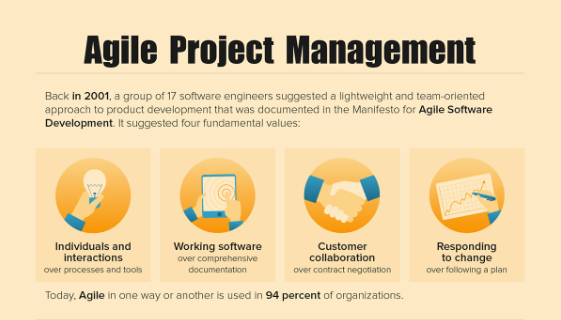
It is critical to note that agile is not a methodology, but an approach that can utilize a variety of methodologies. Agile uses organizational models based on people, collaboration, and shared values. The Agile Manifesto outlines the primary tenets of the agile philosophy. It uses rolling wave planning, iterative and incremental delivery, rapid and flexible response to change, and open communication between teams, stakeholders, and customers. Examples of agile methodologies include SCRUM, XP. Lean, and Test-Driven Development (TDD).

A Brief History of Agile

The frustrations of applying sequential project management methods to software development resulted in the emergence of Agile. A group of leading software developers met in Snowbird, Utah, the USA in 2001 to discuss their challenges. They ultimately created the Agile Manifesto. What the software industry needed was greater agility– new methods that allowed for changes without significantly impacting cost and production schedules.

By dividing production into small components (called iterations) that could be simply and rapidly developed and tested, modifications could be made without having to wait for the end product. Now agile methods are utilized in a variety of industries beyond software development, such as telecommunications, aerospace, and construction , as well as being blended with more traditional, linear project management approaches.

The value of agile principles and practices

Organizations who use agile principles and practices have documented the value they see from the philosophy and techniques:

  • Adaptive to changing business needs, giving the organization more influence over adding, changing, or removing requirements
  • Early and continuous customer feedback improves communication and empowers business owners who can receive and review critical information necessary to make decisions to steer the project throughout the development process.
  • Early measurable return on investment.
  • High visibility and influence over the project progress leading to early indications of problems.
  • Incremental delivery rather than a single complete delivery at the end of the project; reduces product and process waste

Examples of agile principle and practices

The following examples help illustrate the application of agile principles and practices:

  • Early, measurable return on investment through defined, iterative delivery of product increments.
  • High visibility of project progress, allows early identification and resolution or monitoring of problems.
  • Continuous involvement of the customer through the product development cycle.
  • Empowerment of the business owner to make decisions needed to meet goals.
  • Adaptation to changing business needs, giving more influence over requirement changes.
  • Reduced product and process waste

Agile and Market Opportunities

Worldwide, agile project management methods are being embraced by more and more organizations. PMI survey data reveal that most hiring managers think a certification in agile project management would be valuable to their firms. Moreover, practitioners believe that agile certification would be beneficial to their careers.

The PMI-ACP® was developed to help project management practitioners thrive in the challenges of globally-distributed teams, shifting requirements, and the need for rapid responses. It is meant for those with experience leading or working on agile project teams, and who have knowledge of a variety of agile approaches.

This PMI-ACP® certification recognizes knowledge of agile principles and practices across agile methodologies (including Scrum, Lean, Kanban, etc.), not simply limiting a practitioner to one agile approach. The certification can be used in a variety of roles, and any member of an agile team may be eligible to apply. It is also important to note that it can be used in a variety of projects and industries, not just in IT. Lastly, PMI-ACP® does not require PMI’s PMP® certification as a prerequisite.

The PMI-ACP® certification recognizes an individual’s expertise in using agile practices in their projects, while demonstrating their increased professional versatility through agile tools and techniques. In addition, the PMI-ACP® certification carries a higher level of professional credibility in project management as it requires a combination of agile training, experience working on agile projects, and an examination on agile principles, practices, tools, and techniques.

This global certification also supports individuals in meeting the needs of organizations that rely on project practitioners to apply a diversity of methods to their project management. It specifically validates a practitioner’s ability to understand and apply agile principles and practices.

PMI-ACP Certification Benefits

The PMI-ACP® certification delivers strong positive outcomes to practitioners. It is a certification that is more credible than other certifications that are based only on exams or training. This certification enables practitioners to:

  • demonstrate to employers their level of professionalism in agile principles, practices, tools, and techniques; and
  • increase their professional versatility in project management tools and techniques.

The Agile Project Management Approach Read More »

Shopping Cart