blog

the three pillars of scrum

Scrum is regarded as the Agile product development framework’s beating heart. Scrum was developed as a simple but effective approach for product development teams to adopt in order to produce high-quality products quickly. This approach combines incremental and iterative procedures to get around problems that are frequently present with conventional approaches, such as the Waterfall technique.

Pillars of Scrum

To create the optimal product, the Scrum theory focuses on observation and experimentation. This is made possible by process control, which is based on transparency, inspection, and adaptability. The Three Pillars refer to these three empirical process controls.

Scrum’s first pillar is transparency. This pillar is predicated on the notion that developers want process transparency in order to make decisions. By having a clear vocabulary about what is happening throughout the process, the team will be more likely to comprehend what they are doing. The Product Backlog, Task Boards or Burndown Charts, Daily Scrums, Sprint Reviews, Definition of Done, and Retrospective are all ways that Scrum promotes transparency. You can see that the transparency pillar is evident at several points during the Scrum process. This is an important advantage since it shows the team members who are responsible for the project that they are valued for their work in achieving the goal.

The second pillar of Scrum is inspection. Constant inspection is used to produce better results while preventing difficulties in the product development process. Additionally, Scrum users must make sure that they examine the final product and the artefacts during a Sprint. Customers’ reviews can also be a process of inspection in which developers look over the customers’ open and sincere input to make adjustments. Typically, during the Scrum Artefacts process, inspections take happen. Towards the end of a goal, the team typically inspects the product to look for any problems or differences. The deliverables are examined and customer and stakeholder input is gathered on the Scrum board, which also serves as the foundation for the inspection. Furthermore, the inspection could also be based on the Product Backlog and approval granted by the Product Owner.

The third and last pillar of the Scrum methodology is adaptation. Teams should be willing to swiftly adapt to the new demands when a turning point in the product development process occurs. Applying the third pillar of the Scrum process incorrectly results in failure to adapt to the changes. In the context of Agile, the agile approach includes adaptation. The teams must always look for ways to adapt and improve by altering what isn’t working for what will. During the Daily Scrum, a project’s adaptive phases start. The Scrum Team must conduct small tests to determine what is not functioning, then fix the problems during meetings. The Scrum Team will solicit input on the product during the Sprint Review phase in order to include the requested features into the final release. Additionally, the team will talk about internal issues and fresh concepts during the Sprint Retrospective process in order to prepare for a new strategy that adds more value to the product.

The Three Pillars of Scrum – Empirical Process Read More »

Let’s start with an illustration of how tough business analysis work maybe when you don’t know where to start. Business analysts might begin their careers in a variety of ways. In the past, it was not uncommon for young software engineers to migrate into the business side of a company, when their boss summoned them into their office and said, “We are short-staffed, and I need you to find out what the users need this new software application to perform,” The inexperienced business analyst needed to figure out who to talk to, what questions to ask, how to ask them, and how to document what they learned in a way that made sense to the development team and the company.

In this case, completing the fundamental business analysis tasks took far longer than it appeared to. These unprepared rookie business analysts had a hard time figuring out where to begin. There was no system in place to lead them, and no one to direct them in the correct way. They found themselves wishing to return to their desks and continue programming. Fortunately, business analysts no longer have to feel this way. Standards, books, websites, blogs, and a plethora of experienced individuals are all available to advise and guide business analysts in completing their tasks correctly.

Business analysis is the glue that holds successful companies together. It’s a unique discipline that focuses on recognizing company requirements, issues, and opportunities, as well as for deciding the best ways to handle them. Systems development, process improvement, organizational transformation, or a mix of the three may be the emphasis of the projects and initiatives that arise. Strategic, tactical, and operational aspects of a company are all touched by business analysis. Business analysts work on all areas of an organization’s enterprise architecture, stakeholder demands, business processes, software, and hardware across the project and product life cycles.

The BABOK® (Business Analysis Book of Knowledge) Guide from the international institute of business analysis (IIBA) focuses on developing the foundational skills needed to be a successful business analyst on today’s projects and initiatives. Business analysis, according to the BABOK® Guide, is “the activity of enabling change in an organization by defining needs and offering solutions that provide value to stakeholders.” Simply said, a business analyst is someone who does these business analysis tasks.

When it comes to business analysis in an organization, it’s important to understand how the company sees its analysts. First and foremost, what is a business analyst’s role? Second, what is the intended working relationship between the project manager and the business analyst? Third, who are the stakeholders with whom the business analyst will be dealing as the project progresses?

What is Business Analysis? Read More »

project management methodologies

It is often helpful for project managers to rely on existing frameworks and techniques when embarking on a new project. These frameworks are known as project management methodologies. A methodology is a set of tools and techniques that a project manager can use to begin to plan, design, and execute a project. While there are dozens of different methodologies project managers can choose from, there are three main approaches that can be effective across project types and industries: the Waterfall Methodology, the Agile Methodology, and a Hybrid Approach that combines principles of the aforementioned two methodologies.

THE WATERFALL METHODOLOGY

This is considered the most traditional approach to project management. Those who utilize the Waterfall method start by developing a clearly defined scope, schedule, and cost for the project, and then execute based on that scope. This approach aims to ensure all expectations set during the planning phase are met in a timely and effective manner. This method allows project managers to approach their work in a very linear, controlled way, and it is often utilized within the construction industry.

THE AGILE METHODOLOGY

The Agile approach, which falls within the greater Scrum Methodology, allows for maximum flexibility during a project’s execution. In many cases, a project manager works to define the scope of the project while the project development is already underway. To accomplish this high level of flexibility and change, project managers that utilize the Agile approach must establish an open dialogue with stakeholders and internal teams. They often also work on projects in iterative rounds—known as sprints— while guiding the project closer to a final conclusion. This project management methodology is popular among software developers who often begin projects without knowing exactly what their final product might look like.

A HYBRID APPROACH

Project managers [often] want to try to apply one methodology to all projects, but that doesn’t really work. Instead, using a hybrid approach and combining the relevant features of different methodologies when necessary to fit the needs of a specific scope of work. You want to have the necessary understanding of the different methodologies available in project management so that you can apply [the different aspects of each] to different project needs.

Project Management Methodologies Read More »

scrum overview

A Scrum project involves a collaborative effort to create a new product, service, or other result as defined in the Project Vision Statement. Projects are impacted by constraints of time, cost, scope, quality, resources, organizational capabilities, and other limitations that make them difficult to plan, execute, manage, and ultimately succeed. However, successful implementation of the results of a finished project provides significant business benefits to an organization. It is therefore important for organizations to select and practice an appropriate project management approach.

Scrum is one of the most popular Agile methods. It is an adaptive, iterative, fast, flexible, and effective framework designed to deliver significant value quickly and throughout a project. Scrum ensures transparency in communication and creates an environment of collective accountability and continuous progress. The Scrum framework is structured in such a way that it supports product and service development in all types of industries and in any type of project, irrespective of its complexity.

A key strength of Scrum lies in its use of cross functional, self organized, and empowered teams who divide their work into short, concentrated work cycles called Sprints.

The Scrum cycle begins with a Stakeholder Meeting, during which the Project Vision is created. The Product Owner then develops a Prioritized Product Backlog which contains a prioritized list of business and project requirements written in form of User Stories. Each Sprint begins with a Sprint Planning Meeting during which high priority User Stories are considered for inclusion in the Sprint. A Sprint generally lasts between one and six weeks and involves the Scrum Team working to create potentially shippable Deliverables or product increments. During the Sprint, short, highly focused Daily Standup Meetings are conducted whereby team members discuss daily progress. Towards the end of the Sprint, a Sprint Review Meeting is held during which the Product Owner and relevant stakeholders are provided a demonstration of the Deliverables. The Product Owner accepts the Deliverables only if they meet the predefined Acceptance Criteria. The Sprint cycle ends with a Retrospective Sprint Meeting where the team discusses ways to improve processes and performance as they move forward into the subsequent Sprint.

An Overview Of Scrum (Agile Methodology) Read More »

In recent years, organizations have come to understand the critical importance of projects to drive business results, which has led to the widespread acceptance of the profession of project management and the emergence in its own right of the profession of business analysis. These developments have prompted project sponsors, team leads, and team members to consider how these two professions fit into the project framework. Unclear roles and responsibilities, confusion over job titles, and differing organizational expectations for project management and business analysis roles can create confusion and conflict that contributes to less successful project outcomes. For project managers, there may be a perception that business analysts are collecting requirements without effective coordination. There is a fear of being left “out of the loop” and that the business analyst may create unrealistic expectations among project stakeholders regarding project commitments. For business analysts, there may be a perception that project managers do not understand the breadth and complexity of defining, analyzing, and managing requirements and are unwilling to fully investigate and address stakeholder needs.  

While the focus of the project manager is on the scope of the project, the focus of the business analyst is on the scope of the product, which is the solution to be delivered by the project. When projects and programs allocate the roles of project manager and business analyst, success often depends on how well these individuals collaborate. Both serve in critical leadership roles in projects and programs. Each must work together to build successful outcomes and relationships because business analysis activities are indeed focused on projects and programs. In fact, 83% of the work in highly mature organizations is in support of projects and programs. 

For many organizations, effective business analysis is not an integral part of their project work. That contributes to projects not delivering the intended value. However, driven by the rise in project complexity, we see that business analysis is becoming a key competency to project success. When business analysis is properly accounted for and executed on projects and programs, high-quality requirements are produced; stakeholders are more engaged; the solution delivers intended value; and projects are more likely to be delivered on time, within scope, and within budget.

Organizations can utilize business analysis to positively affect projects and programs in order to realize stated objectives and achieve expected results. Simply assigning resources to perform business analysis activities is not enough. Business analysis is a foundational competency that enables successful outcomes in project, program, and portfolio management. While the project may deliver the solution on time and on budget, there is a high probability the solution will not address the business need or deliver the intended value when business analysis is not embraced.

When senior management values business analysis, it sets a precedence. Project teams may champion and support business analysis, but support at the tactical level is not enough. When senior managers truly understand the untapped potential that a highly mature business analysis practice can provide their organization, process changes can be made that ensure business analysis is incorporated into activities inside and outside of the project life cycle. 

To achieve repeatable project success, Matthew W. Leach, Senior Director, Business Analysis Practice at NTT Data, Inc. feels organizations need to focus their attention on making business analysis efforts and outcomes consistent and predictable. “Improving business analysis maturity accomplishes this goal,” he said. 

Business analysis connects an organization’s strategy and objectives with tactics and execution, ensuring business value is realized from the solutions delivered during program and project execution,” added NTT’s Mr. Leach.

Organizational strategies are achieved through the successful completion of projects and programs, and
business analysis ensures this success. Business analysis guides the organization toward solving the right problem
or pursuing the right opportunity. It ensures the best solution is pursued through proper analysis. Mature organizations are also achieving higher success rates from their projects and programs by ensuring the development of business cases. Business analysis activities involve developing a business case to:  

  • Communicate the rationale for funding a project or program
  • Present the viable options for addressing the business need
  • Emphasize the value the organization seeks from the investment

The business case is a tool that drives the product team and key stakeholders to have discussions about these factors and, ultimately, to communicate the decisions to be made. The process to develop a business case is an important opportunity for the strategic resources—including portfolio and program managers—to collaborate with the business analyst to work through the definition of the business need and viable options.

In conclusion, successful projects require a high level of collaboration between both the project, program, or portfolio manager and business analyst. Risks are minimized and project and product success rates improve when these critical roles are aligned and operate in partnership. When this alignment is missing, project performance, customer satisfaction, team morale, and the end product will be adversely impacted.

Business Analyst and Project Manager’s Collaboration for Project Success Read More »

agile project management

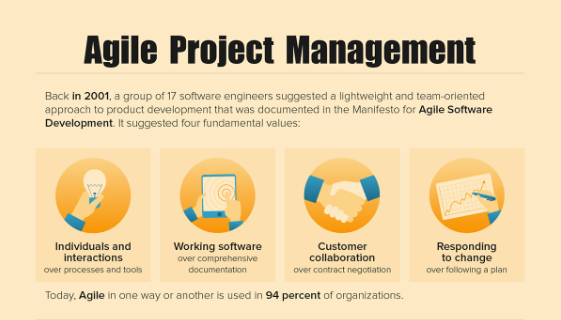
It is critical to note that agile is not a methodology, but an approach that can utilize a variety of methodologies. Agile uses organizational models based on people, collaboration, and shared values. The Agile Manifesto outlines the primary tenets of the agile philosophy. It uses rolling wave planning, iterative and incremental delivery, rapid and flexible response to change, and open communication between teams, stakeholders, and customers. Examples of agile methodologies include SCRUM, XP. Lean, and Test-Driven Development (TDD).

A Brief History of Agile

The frustrations of applying sequential project management methods to software development resulted in the emergence of Agile. A group of leading software developers met in Snowbird, Utah, the USA in 2001 to discuss their challenges. They ultimately created the Agile Manifesto. What the software industry needed was greater agility– new methods that allowed for changes without significantly impacting cost and production schedules.

By dividing production into small components (called iterations) that could be simply and rapidly developed and tested, modifications could be made without having to wait for the end product. Now agile methods are utilized in a variety of industries beyond software development, such as telecommunications, aerospace, and construction , as well as being blended with more traditional, linear project management approaches.

The value of agile principles and practices

Organizations who use agile principles and practices have documented the value they see from the philosophy and techniques:

  • Adaptive to changing business needs, giving the organization more influence over adding, changing, or removing requirements
  • Early and continuous customer feedback improves communication and empowers business owners who can receive and review critical information necessary to make decisions to steer the project throughout the development process.
  • Early measurable return on investment.
  • High visibility and influence over the project progress leading to early indications of problems.
  • Incremental delivery rather than a single complete delivery at the end of the project; reduces product and process waste

Examples of agile principle and practices

The following examples help illustrate the application of agile principles and practices:

  • Early, measurable return on investment through defined, iterative delivery of product increments.
  • High visibility of project progress, allows early identification and resolution or monitoring of problems.
  • Continuous involvement of the customer through the product development cycle.
  • Empowerment of the business owner to make decisions needed to meet goals.
  • Adaptation to changing business needs, giving more influence over requirement changes.
  • Reduced product and process waste

Agile and Market Opportunities

Worldwide, agile project management methods are being embraced by more and more organizations. PMI survey data reveal that most hiring managers think a certification in agile project management would be valuable to their firms. Moreover, practitioners believe that agile certification would be beneficial to their careers.

The PMI-ACP® was developed to help project management practitioners thrive in the challenges of globally-distributed teams, shifting requirements, and the need for rapid responses. It is meant for those with experience leading or working on agile project teams, and who have knowledge of a variety of agile approaches.

This PMI-ACP® certification recognizes knowledge of agile principles and practices across agile methodologies (including Scrum, Lean, Kanban, etc.), not simply limiting a practitioner to one agile approach. The certification can be used in a variety of roles, and any member of an agile team may be eligible to apply. It is also important to note that it can be used in a variety of projects and industries, not just in IT. Lastly, PMI-ACP® does not require PMI’s PMP® certification as a prerequisite.

The PMI-ACP® certification recognizes an individual’s expertise in using agile practices in their projects, while demonstrating their increased professional versatility through agile tools and techniques. In addition, the PMI-ACP® certification carries a higher level of professional credibility in project management as it requires a combination of agile training, experience working on agile projects, and an examination on agile principles, practices, tools, and techniques.

This global certification also supports individuals in meeting the needs of organizations that rely on project practitioners to apply a diversity of methods to their project management. It specifically validates a practitioner’s ability to understand and apply agile principles and practices.

PMI-ACP Certification Benefits

The PMI-ACP® certification delivers strong positive outcomes to practitioners. It is a certification that is more credible than other certifications that are based only on exams or training. This certification enables practitioners to:

  • demonstrate to employers their level of professionalism in agile principles, practices, tools, and techniques; and
  • increase their professional versatility in project management tools and techniques.

The Agile Project Management Approach Read More »

visualprojectmanagementusingkanban

Kanban is a way of thinking about and managing work that can bring discipline and focus on the way your team works. Kanban provides that clarity through this one concept: Visualize your workflow. Visualizing your workflow might sound like an overly simplistic solution, but it can truly work wonders on your team’s ability to work with clarity and purpose. By encouraging teams to identify, prioritize, and intentionally complete work items one at a time, Kanban can help combat the damaging effects of multitasking in a hyper-stimulated world. You do this by figuring out upfront what steps need to be taken on a piece of work and then doing them in that order. Sounds simple, right? But most of our processes are far from linear.

Think about the last project you completed, and the process it went through to go from To Do to Done – was it linear? Did it move smoothly through your process, or did it stop and start and backtrack? Did you finish it on time, or did it take you longer than expected?

Visualizing your workflow will help you define the steps in your team’s process, and refine your process steps to continue to cut out wasted effort, time, and activity.

KANBAN BOARDS AND CARDS

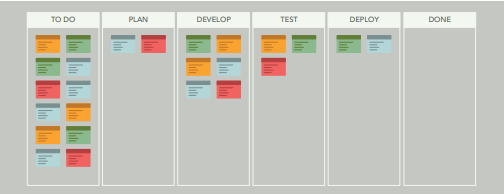
Now that you know the what of Kanban, let’s discuss the how. Kanban uses boards – Kanban boards – to represent your process, and cards to represent your work items. Every Kanban board reflects some version of this basic workflow: To do > Doing > Done

The first step to practising Kanban is to customize your board to accurately reflect your unique process. Here are some examples of different Kanban boards for a Marketing team, an IT operations team, and an HR department.

Marketing | Backlog > Planning/Research > Testing > Implementation > Analysis > Done

IT Operations | Incoming Request > Ready > In-Flight > Delivered

HR | To Do > Planning > Doing > Reviewing > Done

Then, you’ll want to populate your board with cards. Kanban cards represent tasks and serve as visual reminders
of what needs to get done, that you can physically move through your process as you go

FOUR PRINCIPLES OF KANBAN

A Kanban board gives a real-time snapshot of backlog and work in progress, making it easy to decipher what work needs to be done and when. While anyone can visualize tasks on a board, your team isn’t really practising Kanban unless you’re following these four principles.

Visualize All Work

 In order to visualize work, a team must first map out their workflow and break it down into its core stages. Each lane in a Kanban board is then configured to match those stages or handoffs. As work items are initiated, they are made into cards and placed in the appropriate lane. By making the workflow visible in this way, teams can observe the flow of work as well as who is working on what. This visibility alone leads to increased communication and collaboration among team members. Mapping your process as a team is an important step in getting started with Kanban, with as a team being the key phrase. Working collaboratively with everyone on your team to define your process will help to ensure that the workflow you decide to map out on your Kanban board accurately reflects the way your team works. You might be surprised by how much you’ll learn about your process!

Focus On Flow

In addition to limiting work in progress, Kanban allows teams to focus on process flow in a more visual manner. Being able to see the process in action allows teams to identify elements of the process that may have gone unnoticed without the visual representation. For example, by assigning each card to a team member, managers can see who on the team is working at capacity and who could take on more work items. Other team members can also see who may need help with work items at any given time. They can also see where projects are getting held up in the process so that inefficiencies can be identified, and work together to regain a healthy flow of work through the system.

kanbanworkflow

Limiting Work In Progress

One of the benefits of increased visibility, as discussed above, is having one shared view of work in progress. When teams have too many items in the Work in Process (WIP) lane, it can lead to task switching, which causes people to lose focus and confuse prioritization. Without a system to prioritize one task over another, everything feels urgent – making you far more likely to engage in multitasking. All too often, we feel as though we have to be available at all times so that we don’t miss anything – we have to have Slack notifications, email notifications, etc. that follow us everywhere we go. Kanban can help us to minimize distractions by providing a system by which we can prioritize work. When an unplanned work request comes in, as a team, you can look at your board and say, “We’re working on finishing task A right now, but then we will have capacity to help you with task B. We will reach out to you when we are ready to help with task B.” By simply implementing a limit to the amount of work in progress at any given time, you can reduce the time it takes for a work item to move through your team’s process. Furthermore, teams and managers can easily identify bottlenecks and queues that may be slowing down the process or preventing the team from working as efficiently as possible. Not only can this improve the quality of the end product, but it can help teams save significant time and resources overall.

kanbanworkflow

Practice Continuous Improvement

Yes – it’s true that the goal of continuous improvement is to help teams improve, continuously. But in the context of Kanban, continuous improvement is far more than that. It refers to the operationalization of improvement activity within an organization: The shared mindset and set of practices that, when done consistently, promote data-driven analysis and effective process improvement, and encourage innovation and growth across the organization. This doesn’t happen on day one of practicing Kanban – it’s the product of Kanban maturity. In order to practice true continuous improvement, organizations need to first master other key elements of Kanban: Namely, increasing visibility, actively managing flow, and using Lean metrics to measure your progress. Through these steps, you can unlock the power of continuous improvement.

Visual Project Management using KANBAN Read More »

customer service

Your business won’t survive without customers, and you need to get across how much you value them. To communicate well externally, you need to have in place a clear, consistent internal communication strategy too. If you have a team of people working with you, let them know how they each contribute to your business’s success, and the way they interact with your customers is a key part of this.

Making it Happen

Communicate clearly

When a company changes its focus toward customer service, it is essential that everyone is involved. Change creates an atmosphere of uncertainty, so it is vital that everyone understands the important issues and feels that they can contribute to the success of the change. In an atmosphere of uncertainty, customer service levels can be affected.

Build Understanding

Organizational changes can have a significant impact on employees, suppliers and distributors-so it is vital that they are thoroughly briefed. Change can be a powerful positive factor rather than a cause for concern and change can demonstrate that a business is committed to improvement and progress.

REGISTER FOR CUSTOMER RELATIONSHIP MANAGEMENT TRAINING

Encourage Commitment

Implementing a customer service policy requires commitment and involvement from all employees. Before implementing a program, it is sensible to find what the level of commitment is and to include staff in discussion. The most important part of the the process is the follow up. Too many employees believe views will be ignored.

Encourage Improvement

As far as possible, training should be offered to all staff to help them understand the importance of customer care A customer satisfaction guide could be issued, describing the most important elements of customer service and the standards which apply.

REGISTER FOR CUSTOMER RELATIONSHIP MANAGEMENT TRAINING

Maintain Motivation

Motivation and award programs can help to maintain high levels of interest in the customer service program and to build a high level of commitment to the program’s success. Award programs that reward continued improvement in levels of customer satisfaction maintain momentum and give customer service program a high profile. They are therefore valuable in building team spirit and a commitment to excellence.

Provide a Vision

Clear visions and strong, motivating language focus attention on the importance of customer service programs. It is also essential that the program is led from the top. A key figure should be involved personally in every aspect of the programs – talking to groups of employees appearing in company intranet broadcasts and using every public relations opportunity to raise the profile of the program.

Develop Champions

The leader cannot achieve all the objectives alone, so it is essential that other people with influence can take on the role of supporting the message throughout the business. Management commentators often call these people “champions” their task is to build commitment and enthusiasm for change. They may be the very people who could undermine change if left out of the process.

REGISTER FOR CUSTOMER RELATIONSHIP MANAGEMENT TRAINING

Develop Dialogue

The great advantage of the technological boom of the last decade is the ability to connect with individuals and groups in a way that is routine, targeted and convenient for all involved. Consider how you can use technology particularly websites, blogs and social networks-to connect with customers and provide great service.

Communicating Customer Service Read More »

reinvent yourself

Reinvention as a word implies a process of deconstruction, a subsequent reconstruction, and a resultant new thing or a new person who exhibits different talents and who pursues different opportunities. The intended payback for reinvention is gaining something that you currently feel is missing in your life, which could be anything from a successful career, to a better financial situation, to a happier work life balance or a complete change of life style. However, reinventing yourself as a reaction to something or a set of circumstances tends to results in a purely cosmetic change as it does not get to the root of why you want your life to be different. In order to reinvent yourself successfully and for the right reasons, you need to do it consciously and deliberately rather than as a knee jerk reaction. This doesn’t mean for a moment that spontaneity and creativity have no role in a life change – indeed, they are valuable forces in this process – but building in reality checks as you go along will do you no harm at all. 

Many of us arrive at a decision points in our careers unexpectedly. For most people, the planned career path is a myth and its unusual to find people who decided what they wanted to do with their careers when they were at school and who then followed the recommended route to get there. When people talk about their jobs, it’s much more common to hear how amazed they are at what they’ve ended up doing – listen for how many times you hear the phrase “I just seemed to fall into it!”. It’s not surprising, then, that many of us eventually realize that we’re not doing what rewards us professionally, emotionally, culturally, or spiritually. 

Below is a series of steps that may help you through the reinvention process. 

  • Conduct a personal audit 
  • Explore your values and beliefs 
  • Think about your dream scenario 
  • Start making changes 
  • Live the changes 
  • Reinvent your self 

Conduct a ‘Personal Audit’
This is the part of the process where you appraise your life from a personal and professional perspective. You could think of it as a “force-field” analysis. Where you write your name in the center of a clean sheet of paper and itemize your life’s pressure and disappointments on the left and the pleasures and delights on the right. Write down everything you think is relevant, including the interests and aspirations that you had early in your career and all the things that have given you happiness since then. From this activity alone, you may be able to see where unacceptable pressures lie but if you cannot, highlight the break points on both sides of the analysis in a highlighter pen so you can easily identify the issues that really need to be addressed. The intention here is to find a way of swinging the balance of your life toward the pleasurable side of the diagram by drawing out the element of your life that characterize you and your preferred role.

Explore Your Values and Beliefs
If something is preventing you from tapping into your natural talents and living your life in line with them, write it down at the bottom of the sheet of paper. These are the barriers that you have to overcome in order to achieve satisfactory reinvention. They usually manifest as fears, for example: “I will lose my income/pension /benefits,” “I have a dependent family and can’t risk letting them down.” “I have hefty financial commitments and won’t be able to meet these if I change my job,” or “ I can’t afford to go back and start something from the beginning at this stage of my career.” All these are fears that you hold without question. So question them. Are they really true? Do they really matter? If you live your life according to these beliefs, how will you feel at the end of your career? Is this acceptable to you?

Think about Your Dream Scenario
Think about what you’d do if you were free from practical or financial limitations and write everything down at the top of your sheet of paper. This is a freeing exercise that may put you in touch with what it is you would prefer to be doing. Don’t reject your ideas because you don’t have enough money or security to achieve them-don’t put more barriers in your way and remember that, with a little imagination and inventiveness, there are ways around the perceived obstacle of money and security.

Start Making Changes
Now that you’ve done the thinking, you can start making changes, small or radical. Working through the process above has allowed you to see your life laid out in front of you and should help you pinpoint the areas that need the most immediate attention. If you have a strong feeling about the need to change something that doesn’t make any sense to you, don’t try to reason your way out of it”; follow your instincts and see what happens. If you curb your impulses by rationalizing them, you’ll end up behaving in the same way time and time again. To others, and indeed to yourself on some levels, your actions may not seem reasonable but see what happens anyway, many people have benefited from taking a risk at points in their life. Taking action first and reflecting later has probably been the pattern of your career to date, so try something new out, see if it works, then adopt or discard your initiative as appropriate.

Live the changes
It’s no good deciding to make changes but then not doing anything about it. Even if the changes seem alien to you to begin with, practice them until they feel normal. Act as if you’re the best artist in your field, the greatest writer, the most successful entrepreneur whatever it is you want to achieve. Once you start behaving like the person you want to be, people will start treating you as if you are that person. You cannot change your life without changing your behavior patterns, and this too hard, try starting with symbolic changes like your clothing or your car.

Reinvent Yourself
You’ll see that reinvention isn’t really what’s going on here. The effect is reinvention; the fact is that you’re bringing to the surface a latent part of your character that seeks full and happy expression. Make the decision to live the way you want to fully and without apology. What’s the worst that can happen?

Reinventing Yourself Read More »

pmi - pba

About the PMI – PBA Certification

Business analysis is a topic of growing importance to projects and programs. The marketplace reflects this importance, as practitioners increasingly embrace business analysis as a technique for uncovering business needs, managing requirements, and creating effective solutions to business problems. The PMI-PBA certification recognizes an individual’s expertise in business analysis, and using these tools and techniques to improve the overall success of projects.   

In addition, the PMI-PBA certification carries a high level of professional credibility. It requires a combination of business analysis training, experience working on projects, and examination on business analysis principles, practices, tools, and techniques. This global certification also supports individuals in meeting the needs of organizations that rely on business analysis practitioners to play key roles on their teams. 

Business Analysis Role Delineation

PMI conducted a Role Delineation Study (RDS) in the development of the certification in alignment with industry best practices. This study determined the level of importance of each of the tasks, tools and techniques, and knowledge and skills required to use business analysis principles and practices in project management. It is the basis for the creation of the examination. The examination for the PMI-PBA certification is a vital part of the activities that lead to earning this certification. Thus, it is imperative that the examination accurately reflect the business analysis practices, tools and techniques being used by practitioners of business analysis.

REGISTER FOR THE PMI – PBA [PROFESSIONAL in BUSINESS ANALYSIS] CERTIFICATION COURSE

The PMI-PBA Role Delineation states that candidates for the PMI-PBA certification

  • Perform their duties under general supervision and are responsible for working with stakeholders to define an organization’s business requirements in order to shape the output of projects and ensure they deliver the expected business benefit. 
  • Spearhead the discovery, analysis and overall management of the requirements for a project.
  • Demonstrate sufficient knowledge and experience to appropriately apply business analysis tools and techniques to enable project success. 

REGISTER FOR THE PMI – PBA [PROFESSIONAL in BUSINESS ANALYSIS] CERTIFICATION COURSE

To be eligible for the PMI-PBA certification, you must meet the following educational and professional experience requirements.

Educational
Background
Business Analysis
Experience
Training in Business
Analysis
Secondary Degree
(High School Diploma,
associate degree or global equivalent)
7,500 hours
(5 years) working as a
practitioner of business analysis.
This experience must have been earned in the last 8 years.
35 contact hours.
Hours must have been
earned in business analysis practices.
Bachelor’s degree or
higher degree (or global equivalent).
4,500 hours
(3 years) working as a
practitioner of business analysis.
This experience must have been earned in the last 8 years.
35 contact hours.
Hours must have been
earned in business analysis practices

REGISTER FOR THE PMI – PBA [PROFESSIONAL in BUSINESS ANALYSIS] CERTIFICATION COURSE

Overview of the PMI-PBA Certification Read More »

Shopping Cart